


Jamie’s Journey: From a 12 Handicap to 5 in 12 Months


What does it actually take to make a significant improvement to your golf?
A new swing? More lessons? More hours on the range? Better equipment?
Jamie Tinsley’s last 12 months are a great example of why the answer is rarely one single thing.
A year ago, Jamie was playing off 12. He had a clear ambition: get to single figures.
Today, his handicap index is 5.2.
That’s a fantastic achievement. But from a coaching perspective, the most interesting part isn’t the number.
It’s how he got there.
Because Jamie’s improvement wasn’t the result of discovering a magic swing thought or suddenly finding an extra 30 yards.
It came from creating the right conditions for improvement — and then sticking with them.
He had a goal
Jamie knew what he wanted.
Getting to single figures was meaningful enough to motivate him, but also realistic enough to build a plan around.
That matters.
Golfers often tell me they want to “get better”. But what does better actually mean?
Lower handicap? Better ball striking? More distance? Fewer three-putts? Breaking 80?
A clear destination gives your practice and coaching a purpose.
For Jamie, the initial destination was simple:
Single figures.
He had the motivation
A goal on its own achieves very little.
Jamie was driven to improve and, importantly, prepared to commit some time to doing it.
He practised. He played. He came for coaching. He worked between sessions.
That doesn't mean golf took over his life. It means that when he gave time to his golf, there was generally a reason behind what he was doing.
Improvement requires some sacrifice. You have to be prepared to invest something — time, effort, money or usually a combination of all three.
Jamie was.
We built a plan
Once we knew where Jamie wanted to go, we could start working out how to get him there.
And this is where I think many golfers go wrong.
They focus almost entirely on the end result.
“I want to get to 9.”
But you can't directly practise becoming a 9 handicap.
Instead, we identified the things within Jamie's game that, if improved, would give him the best opportunity of lowering his scores.
Those became our process goals.
The big handicap goal gave us the destination.
The process goals gave us the route.

He practiced effectively
Jamie wasn't just hitting balls.
His practice had purpose.
There were periods of working on a specific change. There were drills. There was feedback. There was repetition.
But importantly, practice evolved as the skill developed.
The objective wasn't to create a golfer who could perform a drill beautifully on the range.
The objective was to create a golfer who could play better golf.
That's an important distinction.
There's nothing particularly impressive about hitting hundreds of balls if the practice isn't changing what happens when you stand over a shot on the golf course.
We measured progress
One of the advantages golfers have today is that we don't have to rely entirely on opinion.
Using TrackMan, video, 3D motion analysis, testing and performance data, we could measure what was happening.
Was the change actually working?
Was strike improving?
Was dispersion tightening?
Were the numbers moving in the right direction?
And ultimately...
Were scores improving?
Measurement helped remove some of the guesswork.
It also meant that when something worked, we could see it. When something didn't, we could adapt.
That's a far better way to improve than constantly jumping from one idea to another based on how the last five shots felt.
He crossed off his process goals
This is one of my favourite parts of Jamie's journey.
We didn't need everything to improve at once.
One by one, we could start crossing things off.
A particular skill improves.✅
A movement or impact condition becomes more functional.✅
A weakness becomes less costly.✅
Something that once required lots of conscious thought starts becoming more natural.✅
Those small wins accumulate.
And eventually the outcome goal starts taking care of itself.
He wasn't afraid of change
Jamie has also been very good at something golfers often find difficult.
He hasn't become too emotional about change.
Golf improvement isn't always a perfectly straight line.
A different movement can initially feel strange. A new shot can feel uncomfortable. Occasionally something that ultimately helps your game doesn't immediately produce a better score.
Jamie was generally able to accept that.
Rather than judging everything by the next shot, he trusted the process and gave changes an opportunity to work.
That's a huge attribute in someone who genuinely wants to improve.
He was brave enough to take it onto the course
This might be the biggest one.
Eventually, you have to play golf.
Jamie wasn't a range rat who developed a beautiful practice swing but was frightened to use it when his scorecard came out.
He played plenty.
He took new feels, new skills and new shots onto the golf course.
Sometimes they worked. Sometimes they didn't.
But that's where practice becomes performance.
If you only trust a change when there's a basket of balls next to you and no consequence to the shot, you haven't finished learning it yet.
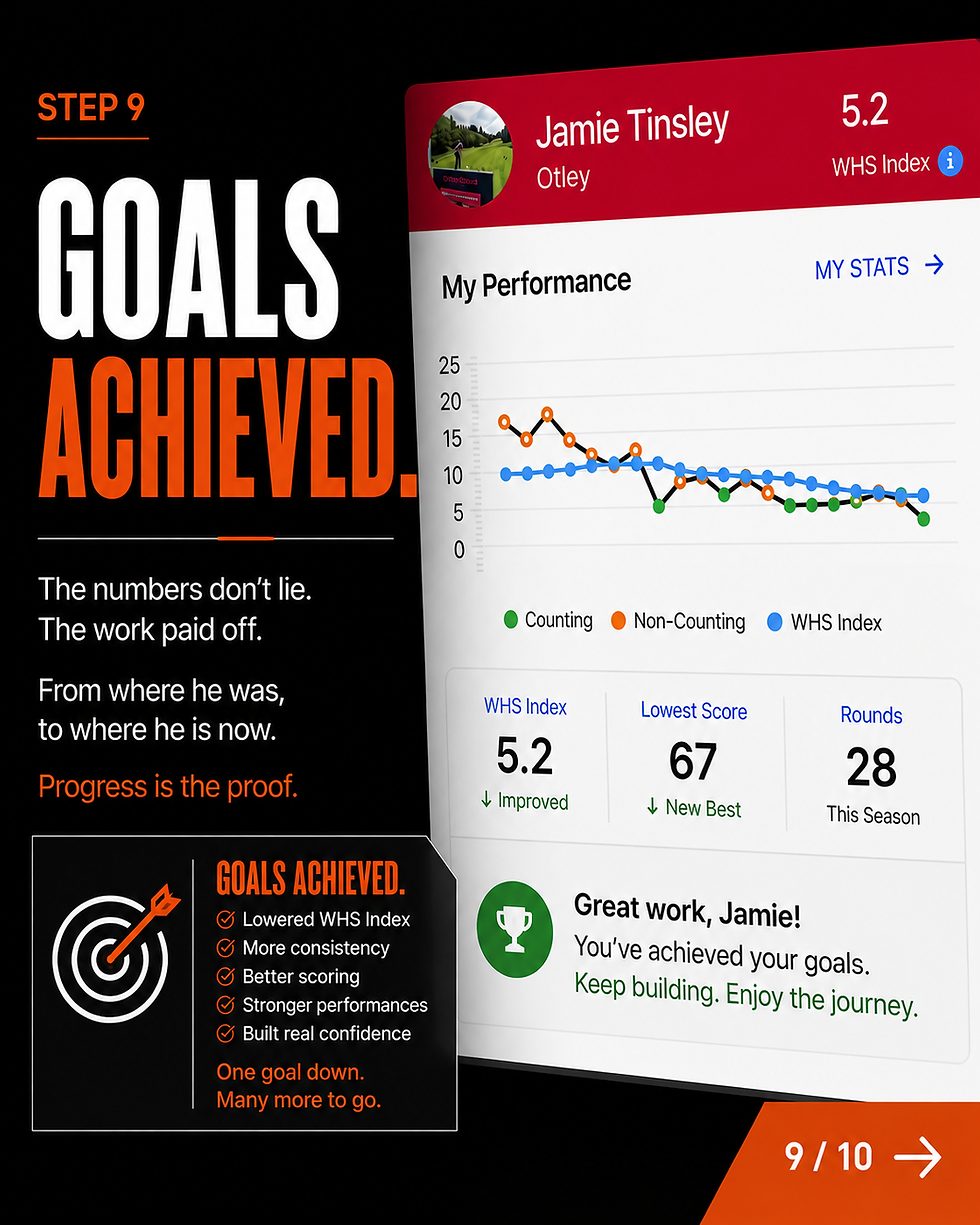
He achieved the goal — then set another one
Jamie got to single figures.
Job done?
Not really.
Once one goal was achieved, we looked at what was next.
And that's perhaps the clearest sign of how his relationship with improvement has developed.
The original target was single figures.
He's now 5.2.
The goalposts have moved because the golfer has moved.
The lesson from Jamie's journey
From my perspective as his coach, Jamie has been pretty much the perfect example of how to approach improvement.
Not because he's done everything perfectly.
Nobody does.
But because he's consistently done the things that give improvement a chance to happen.
He had a goal.He was motivated.He followed a plan.He practised effectively.He measured progress.He crossed off process goals.He accepted good advice.He embraced change.He took it onto the golf course.And, crucially, he did the work.
I've thoroughly enjoyed being part of the journey.
And perhaps the most exciting thing is that it isn't finished.
12 → 5 in 12 months.
The obvious question for every golfer reading this is:
What could YOU achieve in the next 12 months?
If you're serious about improving your golf, don't start by searching for another quick fix.
Start with a goal. Build a plan. Measure what matters. Practise with purpose. Then take it onto the course.
That's how improvement happens.

Comments